You just received your first job offer in Singapore — congratulations! But when you look at the salary figure, a nagging question creeps in: how much of that money will actually land in your bank account? If you have never dealt with CPF before, the numbers can be confusing, even alarming.
Here is the truth most HR letters won’t explain upfront: your gross salary and your take-home pay are two very different things in Singapore. Between mandatory CPF deductions, the updated Ordinary Wage ceiling, and year-end bonuses like the Annual Wage Supplement (AWS), understanding your real income requires a proper breakdown.
Whether you are a university fresh graduate benchmarking your offer or a working professional trying to figure out why your payslip looks the way it does, read on. We will walk you through every number, every rule, and every update that matters in 2026.
What Is CPF and Why Does It Reduce Your Take-Home Pay?
The Central Provident Fund (CPF) is Singapore’s mandatory social security savings scheme. It is not a tax — it is your own money being set aside for retirement, healthcare (Medisave), and housing. However, it does directly reduce the cash you receive each month.
CPF contributions come from two sources simultaneously: you (the employee) contribute a portion of your salary, and your employer contributes an additional amount on top. This dual-contribution model is what confuses many newcomers.
CPF Contribution Rates 2026: Employer and Employee Breakdown
Effective 1 January 2026, CPF contribution rates were updated. Here are the current rates for employees earning more than S$750/month:
| Employee Age | Employer Share | Employee Share | Total Rate |
|---|---|---|---|
| 55 and below | 17% | 20% | 37% |
| Above 55 to 60 | 16% | 18% | 34% |
| Above 60 to 65 | 12.5% | 12.5% | 25% |
| Above 65 to 70 | 9% | 7.5% | 16.5% |
| Above 70 | 7.5% | 5% | 12.5% |
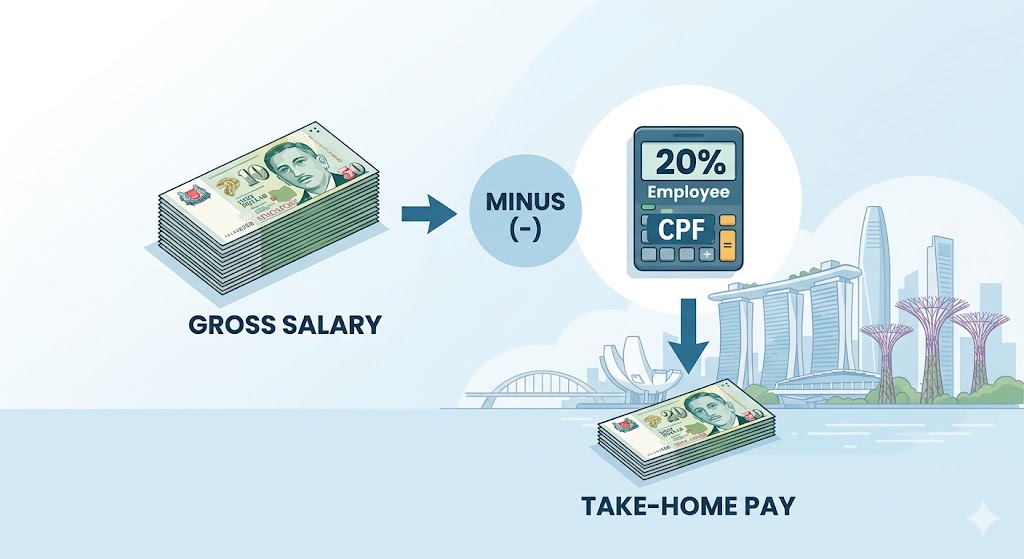
Key point for fresh graduates (typically aged 55 and below): your employee CPF deduction is 20% of your Ordinary Wages, and your employer adds another 17% on top. Your employer’s contribution does NOT reduce your gross salary — it is an extra cost the employer bears.
Minimum Salary for CPF Contribution
The minimum salary for CPF contribution thresholds are as follows:
- S$50 or below/month: No CPF contributions required from either party.
- S$51 to S$500/month: Employer must contribute, but no employee deduction applies.
- Above S$500/month: Both employer and employee contributions are mandatory.
CPF Ordinary Wage (OW) Ceiling Update: Now S$8,000 in 2026
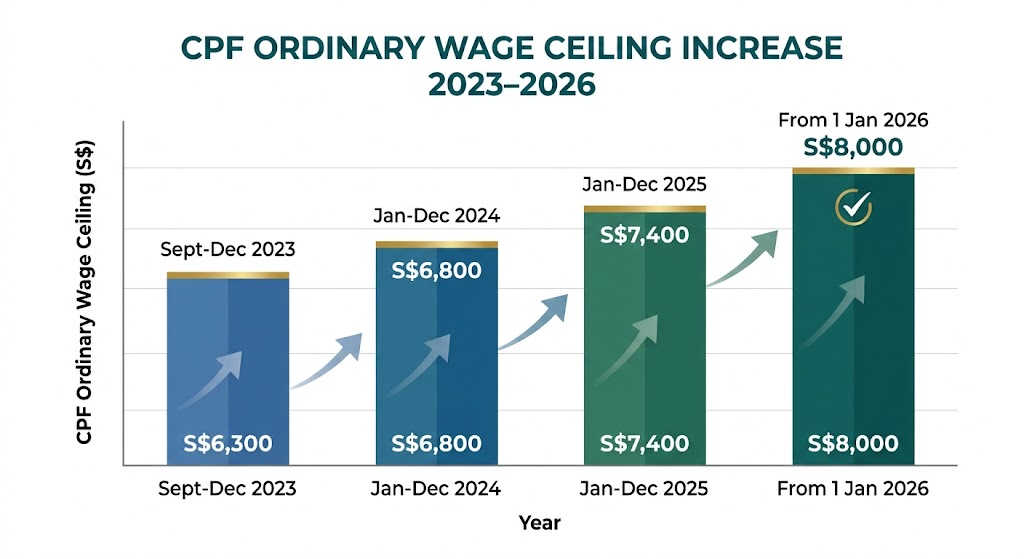
From 1 Jan 2026, the CPF Ordinary Wage (OW) ceiling is S$8,000/month. If your monthly salary is S$10,000, CPF contributions are only calculated on S$8,000. The excess S$2,000 is not subject to the monthly CPF cap.
How to Calculate Take Home Pay After CPF Deduction in Singapore
Formula: Take-Home Pay = Gross Monthly Salary − Employee CPF Contribution (20%)
Example: Fresh Graduate Earning S$4,500/month
- Gross Salary: S$4,500
- Employee CPF (20%): S$900
- Take-Home Pay: S$3,600/month
- Employer CPF (17%): S$765 (extra cost to employer)
Average Starting Salary for University Fresh Graduates in Singapore 2026
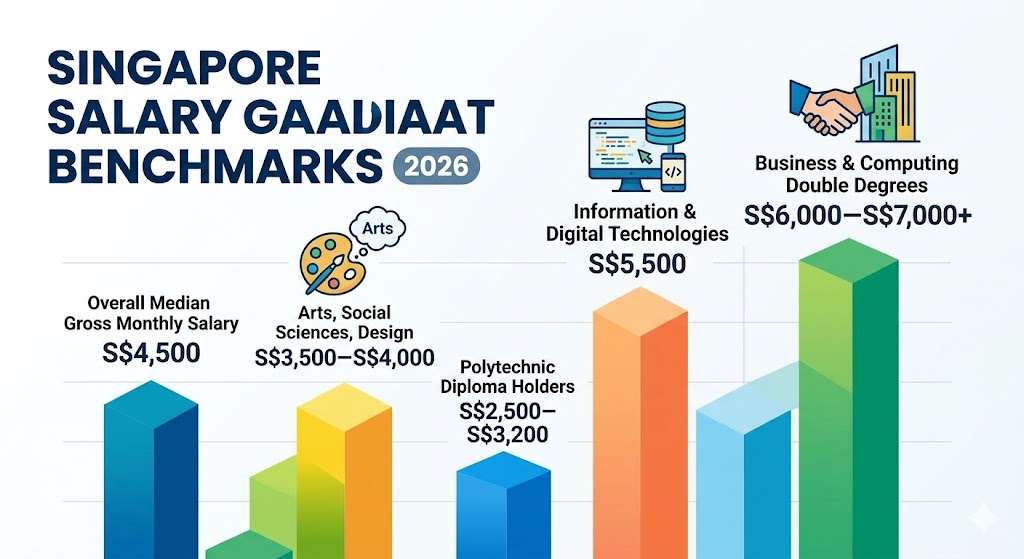
According to the JAUGES 2026 survey:
- Overall Median Gross Monthly Salary: S$4,500
- Information & Digital Technologies: S$5,500
- Business & Computing Double Degrees: S$6,000–S$7,000+
- Arts, Social Sciences, Design: S$3,500–S$4,000
Annual Wage Supplement (AWS) Rules in Singapore
The Annual Wage Supplement (AWS) or “13th month bonus” is an additional payment at year-end. It is not legally mandatory but is standard practice in most contracts. AWS is subject to CPF contributions as “Additional Wages.”
Salary Negotiation Tips for Fresh Graduates 2026
- Always negotiate on gross salary.
- Factor in employer CPF (17%) when comparing total compensation.
- Ask about AWS and bonuses explicitly.
- Leverage specialized skills like AI or cybersecurity.
- Use JAUGES data as a credible reference point.
Frequently Asked Questions
How much CPF contribution comes from employer and employee?
For employees 55 and below, the employee contributes 20% and the employer contributes 17%.
What is the CPF Ordinary Wage ceiling in 2026?
It is S$8,000/month as of 1 January 2026.
Final Thoughts
As a fresh graduate, use the JAUGES benchmark of S$4,500 gross to evaluate offers. Understanding how to calculate take home pay after CPF deduction ensures you make informed financial decisions in 2026.