Are you feeling stuck in your current job? Does the thought of waking up and going to the same workplace every day fill you with dread? You are not alone. Thousands of Singaporeans every year reach a crossroads — they want to do something different, something more meaningful, something that pays better or offers more flexibility.
But the biggest question that holds them back is: “How do I make a mid-career switch in Singapore with no experience in the new field?” The good news is that Singapore is one of the most supportive countries in the world when it comes to helping its citizens navigate career transitions. From generous SkillsFuture subsidies to dedicated government-backed Career Conversion Programmes, there is a structured ecosystem designed to help you make a successful switch — even if you are starting from zero. This guide will walk you through everything you need to know, step by step.
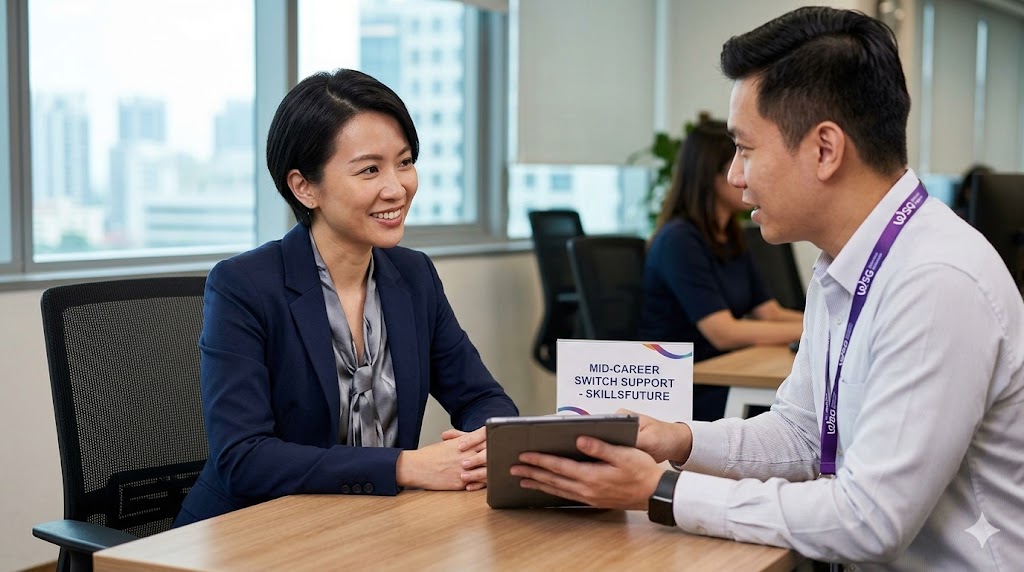
What Is a Mid-Career Switch and Who Is It For?
A mid-career switch refers to a deliberate transition from one industry or job function to a completely different one. This is different from a simple job hop within the same sector. For example, switching from being an accountant to becoming a data analyst, or from a hotel manager to a UX designer, counts as a mid-career switch.
In Singapore, this transition is increasingly common among professionals between the ages of 30 and 50. You might be motivated by:
- A desire for better work-life balance
- Higher earning potential in a growing industry
- Burnout from your current profession
- Passion for a completely different field
- Industry disruption caused by automation or restructuring
Whatever your reason, the important thing to know is this: you do NOT need prior experience in the new field to get started. What you need is the right plan, the right resources, and the right support.
Step 1: Do a Proper Self-Assessment Before You Switch
Before you dive into any course or programme, take time to assess yourself honestly. Ask yourself:
- What are my transferable skills? (e.g., communication, project management, data analysis, customer service)
- What industries are growing in Singapore right now? (e.g., FinTech, Healthcare, Cybersecurity, Green Energy, Digital Marketing)
- What is my financial runway? Can I afford to take a pay cut or study full-time for 3–6 months?
- Am I willing to start at a lower seniority level in the new field?
Answering these questions will help you choose a realistic target career that matches both your passion and the market demand in Singapore.
Step 2: Get WSG Career Guidance and Coaching
One of the most underutilised resources available to Singaporeans is the WSG Career Guidance and Coaching service offered by Workforce Singapore (WSG). This is a completely free service available to all Singapore Citizens and Permanent Residents. Through WSG’s Career Centres, you can access:
- One-on-one career coaching sessions with certified career coaches
- Career profiling tools to identify your strengths and suitable roles
- Industry insight workshops to understand what employers are looking for
- Resume and interview preparation support tailored for career switchers
Step 3: Identify the Right SkillsFuture Course for Your Career Change
If you are searching for the best SkillsFuture courses for career change 2026, you will find hundreds of options across dozens of industries on the SkillsFuture Singapore website. SkillsFuture is a national movement that provides every Singaporean aged 25 and above with a SkillsFuture Credit of S$500, with additional top-ups available for mid-career switchers.
Here are the top in-demand course categories for career switchers in 2026:
- Technology & Digital Skills: Data Analytics, Cybersecurity, Cloud Computing, UX/UI Design.
- Healthcare & Social Services: Community Care, Nursing, Counselling.
- Green Economy & Sustainability: ESG Reporting, Solar Energy Technology.
- Business & Finance: Human Resources Management, Financial Advisory, Logistics.

How to Use the SkillsFuture Credit Claim Process:
Understanding the SkillsFuture Credit claim process is straightforward:
- Log in to the SkillsFuture Credit portal at skillsfuture.gov.sg using your Singpass.
- Search for an eligible course from an approved training provider.
- Enroll in the course and check if it is SkillsFuture Credit-eligible.
- Submit a claim for reimbursement after you have successfully enrolled and the course fee has been charged.
Important: Mid-career switchers (aged 40 and above) are eligible for an additional SkillsFuture Mid-Career Enhanced Subsidy, which can cover up to 90% of course fees. This makes upskilling in Singapore extremely affordable for mature professionals.
Step 4: Apply for a Professional Conversion Programme (PCP) in Singapore
The most powerful tool available to Singaporeans making a career switch is the Professional Conversion Programme (PCP) in Singapore. PCPs are part of the broader suite of Career Conversion Programmes managed by Workforce Singapore (WSG) in partnership with various industry associations and employers.
What is a PCP? A PCP is a structured training and job placement programme that allows you to train for a new job role while often being employed and paid a salary. It is specifically designed for Singaporeans and PRs who want to reskill and move into a new career track — even if they have zero prior experience in that area.
Examples of Available PCPs in 2026: PCP for Data Analysts, PCP for Software Engineers, PCP for Financial Advisers, PCP for Healthcare Support Associates, PCP for Human Resource Professionals.
Step 5: Leverage Workforce Singapore (WSG) Career Conversion Programmes
Beyond PCPs, Workforce Singapore (WSG) manages a broader range of **Career Conversion Programmes** under different formats, including: **Place-and-Train (P&T)**, **Attach-and-Train (A&T)**, and **Redeployment** (within the same company).
WSG works directly with industry partners such as SGTech, the Singapore Hotel Association (SHA), NTUC, and many others to design and deliver these programmes. They are highly industry-relevant and constantly updated to match evolving market demands.
Step 6: Build Your New Career Portfolio Before You Apply for Jobs
One of the biggest challenges of switching careers with no experience is the classic catch-22: employers want experience, but you cannot get experience without a job. Here is how to break the cycle:
- Build portfolio projects: If you are switching to a tech or creative field, build real-world projects you can showcase (e.g., a small website, a data dashboard).
- Do freelance or volunteer work: Platforms like LinkedIn and Upwork are great places to pick up small projects in your new field.
- Earn a relevant certification: Internationally recognised certifications (e.g., Google Data Analytics Certificate) can significantly boost your credibility.

Step 7: Rewrite Your Resume as a Career Switcher
Your resume needs to be completely restructured for a career switch. Here is what to do:
- Lead with a strong professional summary that positions you as a motivated career switcher with transferable skills.
- Highlight transferable skills prominently — communication, project management, stakeholder management, data literacy, etc.
- Use a Functional or Hybrid Resume format rather than a purely chronological one.
- Mention any SkillsFuture or PCP training you have completed, even if it is in progress.
- Tailor your resume to each specific job application using keywords from the job description.
Common Mistakes to Avoid When Making a Mid-Career Switch in Singapore
- **Quitting your job before having a plan.** Always plan your transition before leaving your current employment. You need financial stability while you reskill.
- **Choosing a course just because it is cheap or short.** Focus on market demand and job outcomes, not just convenience.
- **Targeting roles that are too senior in your new field.** Be realistic. You may need to take a step back in terms of seniority or salary initially.
- **Not using WSG and SkillsFuture resources.** Many Singaporeans are unaware of the full extent of support available. Use every resource.
- **Giving up too early.** Career switches typically take 6 to 18 months. Patience and consistency are essential.
Frequently Asked Questions (FAQ)
Q1: Can I make a mid-career switch in Singapore without any experience in the new field?
Yes, absolutely. Singapore’s Professional Conversion Programmes (PCPs) and SkillsFuture courses are specifically designed to help professionals reskill from scratch.
Q2: How much SkillsFuture Credit do I have?
Every Singaporean aged 25 and above gets a base credit of S$500. Mid-career individuals aged 40 and above received an additional top-up. You can check your balance on the SkillsFuture portal.
Q3: How long does a Professional Conversion Programme (PCP) take?
The duration varies by programme, typically ranging from 3 to 12 months.
Q4: Do I need to be retrenched to apply for a WSG Career Conversion Programme?
No. Many Career Conversion Programmes are open to both employed and unemployed Singaporeans.
Q5: Is the WSG Career Guidance and Coaching service free?
Yes, all WSG Career Coaching services are completely free for Singapore Citizens and Permanent Residents.
Final Thoughts
Making a mid-career switch in Singapore — especially with no prior experience in your target field — might feel overwhelming at first. But Singapore offers one of the world’s most robust ecosystems for career transitions. Between the **SkillsFuture Credit claim process**, the **Professional Conversion Programmes (PCP)**, and the **WSG Career Guidance and Coaching** services, every piece of the puzzle is already in place for you. Book a session with a WSG career coach, explore the SkillsFuture course catalogue, and begin mapping out your transition timeline. Your new career is closer than you think.